Omnibus Decree, POS and Receipts: What Really Changes for Your Salon
A 5% tolerance on untracked transactions is coming, but for a salon, real security isn't about the threshold: it's about having total control over your takings, every single day.
A regulatory update that affects you too
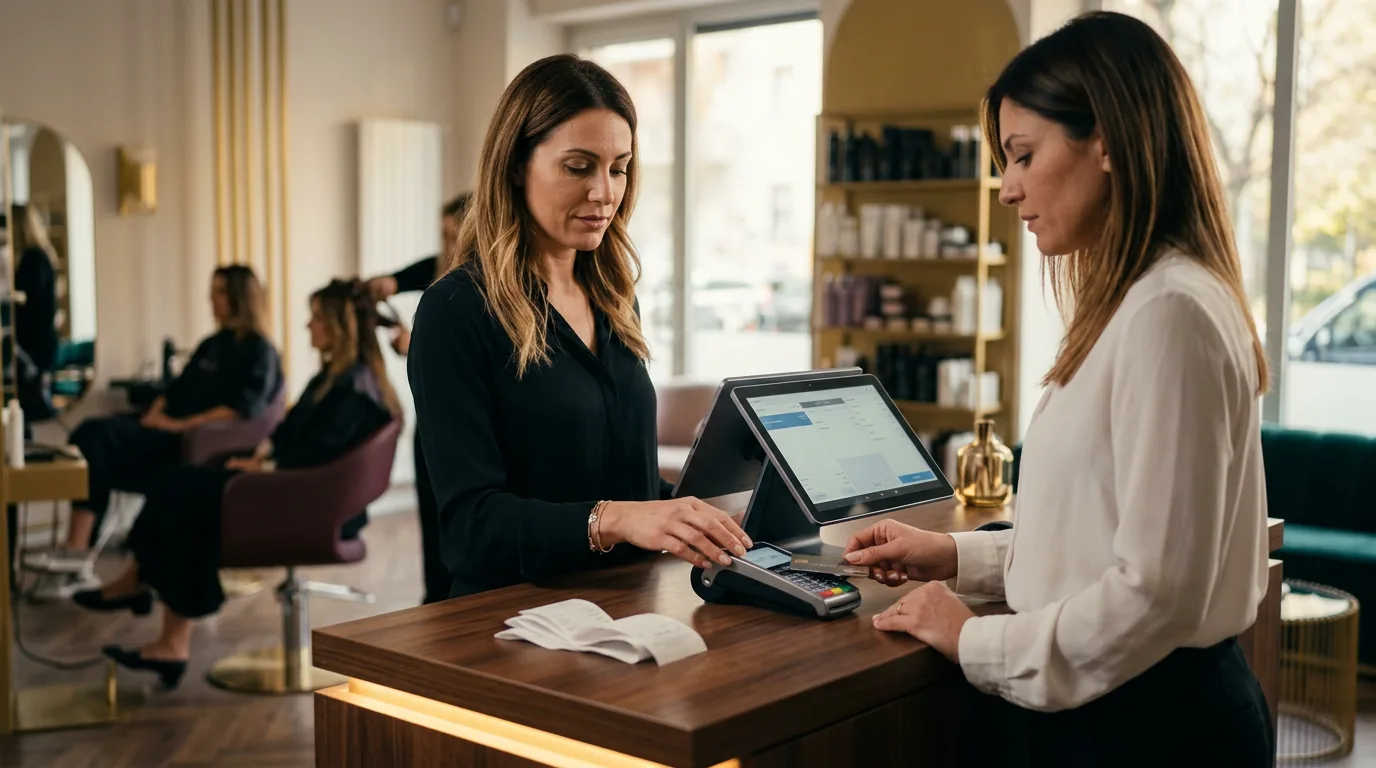
If you run a salon, you've probably already heard about the Omnibus Decree and the new 5% tolerance threshold on the number of transactions related to POS terminals and receipts. In simple terms: the rule introduces a margin of flexibility for those who occasionally fail to accept an electronic payment or make some minor mistake when issuing receipts, without automatically incurring penalties.
This is good news, because it reduces the risk of being punished for sporadic, unintentional errors. But be careful: it's not an excuse to lower your guard. It's the perfect opportunity to think more broadly about how you actually manage your salon's takings.
What the rule really says (without the technical jargon)
For years now, anyone selling goods or services to the public has been required to accept electronic payments in addition to cash. Penalties for those who don't already exist. What changes with this measure is that lawmakers now recognize that, out of a total number of transactions, a 5% margin of exceptions (due to technical issues, a malfunctioning POS terminal, occasional errors) doesn't automatically trigger a penalty.
Translated for a salon that handles, say, 400 transactions a month: you have a theoretical margin of about 20 transactions where, for technical or organizational reasons, something might not go as it should, without this automatically becoming a problem with the tax authorities.
But here's the point we, as BOSS, really want to bring to your attention: the tolerance threshold must not become your goal. It should be a safety net for unexpected events, not a margin for building habits on.
Why tolerance alone isn't enough to protect you
Many salon owners experience tax management as a nuisance to be endured, not as an integral part of the business. The result is that errors accumulate: a receipt not issued because of a rush, a cash payment not recorded properly, a POS terminal that "sometimes doesn't work" because no one checks the connection.
Individually, each of these episodes may fall within the 5% tolerance. But if they become a widespread habit across the whole team, the percentage quickly climbs above the threshold, and at that point the penalty comes anyway, often at a moment you least expect it, perhaps during an audit covering the entire year.
The real question you need to ask yourself isn't "how much margin do I have," but: does my salon have a system that tracks every transaction automatically and correctly, regardless of who's at the register that day?
The real problem: a cash register managed by guesswork
In most of the salons we work with, the issue isn't bad faith: it's disorganization. There's no clear process for who handles payments, how the payment is recorded, what to do if the POS terminal isn't working, or how to manage prepaid packages or last-minute discounts decided on the spot by whichever staff member is on duty.
Every exception handled manually, without a system to catch it, is a potential missing receipt or an incorrectly tracked payment. And when these exceptions multiply across multiple staff members and multiple days, tax risk stops being a remote possibility.
This is where a tool like GoCash changes the rules of the game: it leaves no room for improvisation, because every cash movement is recorded in a structured, consistent, and verifiable way, regardless of who's behind the counter that day.
Building a business culture, not just compliance
This regulatory update is also an opportunity to reflect on a deeper issue: how much your salon is run as a business with method, and how much it still relies on habit and the goodwill of individual staff members.
A salon that operates as a real business doesn't chase tolerance thresholds: it builds processes that make errors rare by nature, not by luck. This means having:
- a single cash management system, shared by the whole team;
- clear procedures for mixed payments, discounts, and refunds;
- periodic checks on takings, not just at the end of the month;
- tax management that isn't only discovered when an audit arrives.
If the tax side of your salon still feels like unclear territory, a program like the Fiscal Mentorship can help you understand not just how to stay compliant, but how to do it in a way that becomes a competitive advantage, not a hidden cost.
A solid salon doesn't need margins for error
The 5% tolerance introduced by the Omnibus Decree is designed to protect you from real unforeseen events, not to normalize carelessness. A salon that truly grows is one that treats every euro passing through the register with the same seriousness it treats an important client.
This is exactly the principle behind our method: turning day-to-day management from a source of anxiety into a growth lever, with tools that work on your behalf and give you real control over the numbers, not just over the tolerance thresholds the law grants you.
If you want to understand how to apply all of this to your salon, take a look at the management tools designed specifically for those who want to stop hoping everything will go well, and start knowing it for certain.